



Starting a side business while working full-time can be exciting and rewarding — but it’s also a balancing act. Whether your goal is to earn extra income, explore your passion, or eventually transition into full-time entrepreneurship, you’ll need the right structure, systems, and strategies to succeed without burning out.
In this guide, we’ll walk you through the key steps to legally set up, organize, and grow your side business in Ontario while keeping your day job. You’ll also learn about time management, scaling strategies, and local resources to help you level up your business.

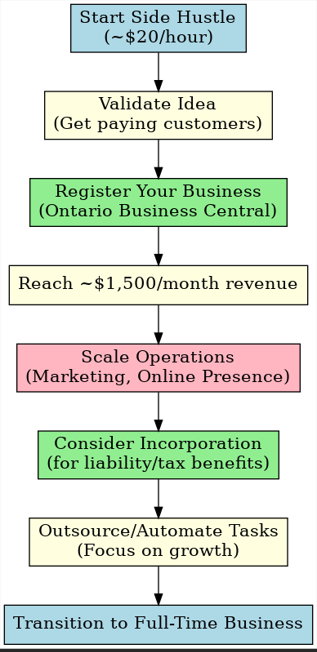
Step 1: Take Care of the Legal Basics
Before you start promoting your products or services, make sure your business is legally registered.
Choose the Right Business Structure:
Most part-time entrepreneurs in Ontario begin as a Sole Proprietorship because it’s affordable, easy to set up, and simple to maintain. If you’re starting with a partner, a General Partnership may be an option. Incorporating from the start offers liability protection and potential tax benefits but comes with more complexity.

Registration Requirement:
If you operate under any name other than your personal legal name, you must register your business with the Ontario Business Registry or through an authorized intermediary like Ontario Business Central.
Protect Your Brand:
Consider conducting a NUANS Preliminary Name Search before registration to ensure your business name is available and unique.
Step 2: Organize Your Time and Tasks
Balancing your job and a side business requires intentional scheduling.
Practical Tips:
- Block time for your business in your weekly calendar.
- Set realistic goals for each week or month.
- Use task management tools like Trello, Asana, or ClickUp.
- Prioritize high-impact tasks that directly drive revenue or growth.
Pro Tip: Treat your business hours seriously — even if they’re evenings or weekends.
Step 3: Understand When to Move From Sole Proprietorship to Incorporation
If your side business is generating steady income, attracting investment opportunities, or exposing you to liability, it may be time to incorporate.
Key indicators it’s time to incorporate include:
- Your net income is high enough to benefit from corporate tax rates.
- You want liability protection.
- You’re hiring employees or contractors.
Ontario Business Central can help you incorporate quickly and easily, whether you want to keep your existing business name or choose a new one.

Step 4: Know Your Tax Obligations
Even as a part-time business owner, you must track your income and expenses for tax purposes.
HST Registration:
You must register for HST if your revenue exceeds $30,000 in a single calendar quarter or over four consecutive quarters. Some part-time entrepreneurs choose to register voluntarily to claim input tax credits.
Step 5: Manage Your Finances Effectively
Having the right tools to track your income and expenses can save time and headaches.
Recommended Tools:
- QuickBooks Online or Wave Accounting for bookkeeping.
- FreshBooks for invoicing and time tracking.
- Google Sheets for basic expense tracking if you’re just starting.
Pro Tip: Keep your business and personal finances separate by opening a dedicated bank account.
Step 6: Scale Without Burning Out
Growth doesn’t have to mean exhaustion. Here’s how to scale strategically:
- Focus on products or services with the highest profit margins.
- Automate repetitive tasks like invoicing, social media posting, and email responses.
- Use batching — completing similar tasks in one session — to save time.
Step 7: Know When to Start Outsourcing
Once your time becomes the limiting factor, consider outsourcing:
- Hire a virtual assistant for admin tasks.
- Use freelancers for specialized work like graphic design or copywriting.
- Partner with other small business owners to share resources.
Step 8: Tap Into Ontario’s Resources & Grants
Ontario offers several programs to help part-time entrepreneurs grow:
- Starter Company Plus – Funding and training for eligible entrepreneurs.
- Futurpreneur Canada – Loans and mentorship for young entrepreneurs.
- Local Small Business Enterprise Centres – Free workshops, networking, and advice.
Step 9: Hit Financial Benchmarks Before Going Full-Time
Before you hand in your resignation, aim to:
- Consistently replace at least 50–75% of your full-time income.
- Have 3–6 months of living expenses saved.
- Build a steady client base or recurring revenue stream.
Step 10: Stay Compliant With Employment Agreements
Check your employment contract to ensure there’s no conflict of interest or non-compete clause. In Ontario, you can legally grow and even incorporate your business while employed, as long as it doesn’t breach your agreement or use your employer’s resources.
Frequently Asked Questions
1. How Do I Know if My Side Business is Ready to Grow?
If you have consistent customers, repeat revenue, and demand that exceeds your current capacity, it’s a sign you’re ready to scale.
2. Do I Need to Register for HST if I’m Part-time?
Only if your annual revenue exceeds $30,000, though voluntary registration is possible.
3. What Tools Can Help Me Stay Organized?
Project management tools like Trello, bookkeeping software like QuickBooks, and scheduling apps like Google Calendar.
4. Can I Legally Grow and Incorporate My Business While Still Employed?
Yes, as long as you comply with your employment contract and do not use your employer’s time or resources.
5. What Grants Are Available in Ontario for Part-time Entrepreneurs?
Programs like Starter Company Plus, Futurpreneur, and regional small business grants may be available depending on your location and eligibility.
Final Thoughts
A side business in Ontario can be a powerful way to explore your entrepreneurial dreams without risking your primary income. By following the right legal steps, staying organized, managing your time effectively, and using local resources, you can grow sustainably — and be ready to go full-time when the moment is right.
Ready to Take the Next Step?
Ontario Business Central can help you register or incorporate your side business quickly and easily, with live Canadian agents ready to answer your questions.
inquiries@ontariobusinesscentral.ca
Toll-Free: 1-800-280-1913
Local: 1-416-599-9009
Fax: 1-866-294-4363
Office Hours: 9:00am – 5:00pm
Monday – Friday E.S.T.
Ontario Business Central Inc. is not a law firm and cannot provide a legal opinion or advice. This information is to assist you in understanding the requirements of registration within the chosen jurisdiction. It is always recommended, when you have legal or accounting questions that you speak to a qualified professional.