



Original Publish Date: Aug 26, 2015
Articles of Incorporation are legal documents used to create an incorporated company. When you file them, your business becomes a separate legal entity that exists apart from you as an individual.

In Canada, Articles of Incorporation formally establish a corporation under provincial or federal law. Once approved, the government issues a Certificate of Incorporation, which confirms that the corporation legally exists.
What Does Incorporated Mean?
When a business is incorporated, it becomes a separate legal entity. This means the business exists separately from its owners.
For many business owners, incorporation provides limited liability protection. This can help protect personal assets if the corporation faces financial or legal issues.
What Do Articles of Incorporation Do?
Articles of Incorporation in Canada legally create a corporation. They define the business as a corporate entity that is separate from its owners, shareholders, and directors.
Once incorporated, the business can:
- Own assets and property
- Sign contracts
- Open bank accounts
- Carry out business activity in its own name
One of the main benefits of incorporation is limited liability. This means the corporation is generally responsible for its own debts and legal obligations. This structure can protect personal assets if the business faces financial or legal issues.
This document also establishes structural details, including:
- The corporation’s legal name or numbered name
- The number of directors and initial board of directors
- The share structure, including the number of shares and class of shares
- Any restrictions on business activities or share transfers
These details help define how the corporation is managed and how ownership is divided between shareholders.
Filing Articles of Incorporation also protects your corporate name within the jurisdiction where you incorporate. No other corporation in that jurisdiction can use the same name.
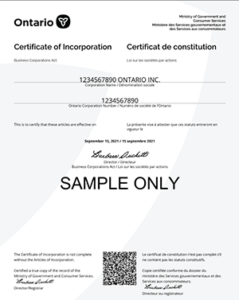
For Articles of Incorporation in Ontario, a sample can help you understand the layout of the document. Our Ontario Articles of Incorporation example shows how details will appear in the official document.
Choosing the right type of business structure is essential, as it impacts taxation, liability, and flexibility.

Reasons to Incorporate Your Business
In Canada, businesses can often choose between registering a Sole Proprietorship or Incorporating. While a Sole Proprietorship may suit certain small businesses, Incorporation offers several benefits:
- Liability Protection: Articles of Incorporation create a layer of separation between the business entity and the owner. Incorporation typically protects your personal assets if the company faces legal issues, unlike a Sole Proprietorship.
- Name Protection: Incorporating protects your corporate name within your jurisdiction, helping you avoid conflicts with similar businesses.
- Tax Advantages: Corporations may qualify for lower tax rates or tax deferrals, helping them save money as they grow.
- Credibility & Professionalism: Many companies prefer to work with incorporated businesses. Filing Articles of Incorporation can make your company more appealing to clients and partners.

How to Get Articles of Incorporation in Ontario or Canada
The process to file Articles of Incorporation varies depending on where you choose to incorporate. Here’s what you’ll need to file in Ontario:
- Name of the Business: You can choose either a numbered name (e.g., 123456 Ontario Inc.) or a custom corporate name (e.g., ABC Holdings Inc.)
- Registered Office: The physical address where the business operates.
- Director Information: Details on directors’ names, addresses, and citizenship status. Federal corporations require 25% of directors to be Canadian residents.
- Share Structure: Defining the class of share and voting rights is crucial when filing Articles of Incorporation. We offer standard structures for one and two classes of shares to simplify this process.
- Restrictions: Any limitations on business activities or transfer of shares, if applicable.
Ontario Business Central can help ensure the process runs smoothly. We assist with each step and guide you through all necessary paperwork.
Where to Order Existing Articles of Incorporation Copies
You can easily order a copy of your company’s Articles of Incorporation or those of another business. OBC offers certified copies of Articles of Incorporation in Ontario for example, and Federal incorporation documents for businesses across Canada. Businesses often need these copies for legal, tax, or registration purposes, such as expanding into another province.
Options for Foreign Owners
Incorporation requirements can differ based on who owns the business. Ontario corporations don’t require directors to be Canadian citizens or residents. Federal corporations, however, must have at least 25% of their directors as Canadian residents. We can guide foreign owners on the best incorporation option based on ownership, location, and business goals.
Common Questions About Articles of Incorporation
What Do Articles of Incorporation Include?
In Canada, a Certificate of Incorporation is issued once a corporation has successfully met all legal registration requirements, signifying its official status as a legal entity. The details included can vary depending on your jurisdiction. Articles of Incorporation in Canada for example typically includes details such as the registered office, business structure, board of directors information, and share structure.
What Does It Mean to Be an Incorporated Company?
What does having an incorporated company mean? Incorporating a business establishes it as a legal entity separate from its owners. This provides liability protection and potential tax advantages, among other benefits.
What Does Incorporation Mean?
Incorporation is the process of legally forming a corporation, creating a distinct legal identity separate from its owners.
How Do I Get Articles of Incorp?
Business owners must file the required paperwork with the correct Provincial or Federal office to obtain Articles of Incorporation. Ontario Business Central offers a streamlined process to help you complete and file these documents efficiently.
What Are the Costs Associated With Obtaining Ontario Articles of Inc?
The filing fee for registering a new business varies depending on the type of entity and jurisdiction. Government fees apply to these services too. Ontario Articles of Incorporation for example have a $300 government fee.
Why Use Ontario Business Central For Incorporation?
Ontario Business Central has over 30 years of experience helping Canadian entrepreneurs start and grow their companies. With our easy-to-use online platform, you can file Articles of Incorporation quickly and efficiently. Under the Business Corporations Act, companies must adhere to specific guidelines for registration, governance, and reporting to maintain compliance.
Each type of corporation offers unique benefits, tax structures, and liability protections, making it essential to understand your options. Our team of experts is here to answer any questions and guide you through a smooth incorporation process.
Contact us for more information. Ontario Business Central is here to help you every step of the way.
- Complete Articles of Incorporation For a New Business in Ontario
- Complete Articles of Incorporation For a New Business in Canada
- Complete Articles of Incorporation For a New Business in Alberta
- Complete Articles of Incorporation For a New Business in B.C.
- Complete Articles of Incorporation For a New Business in Manitoba
- Complete Articles of Incorporation For a New Business in Saskatchewan
inquiries@ontariobusinesscentral.ca
Toll-Free: 1-800-280-1913
Local: 1-416-599-9009
Fax: 1-866-294-4363
Office Hours: 9:00am – 5:00pm
Monday – Friday E.S.T.
Ontario Business Central Inc. is not a law firm and cannot provide a legal opinion or advice. This information is to assist you in understanding the requirements of registration within the chosen jurisdiction. It is always recommended, when you have legal or accounting questions that you speak to a qualified professional.